A Search for Belonging
I was born in Shiraz, Iran. At 27, I left the place where I had grown up and moved with my family first to Toronto and later to the United States.
Over the next thirteen years, I lived in nine different cities. Through all of those moves, I found myself searching for something I couldn’t quite name: home.
As an immigrant, home became a complicated word. Was it where I was born? Where my family lived? Where I happened to be living? For a long time, I never felt that I belonged completely to any one place.
When I eventually came to the San Francisco Bay Area, my understanding of home began to change.
I realized that home, for me, is not simply a place on a map. It is community. It is being surrounded by people with whom I can build meaningful relationships, show up authentically, and experience connection and belonging.
In many ways, that search for home has mirrored my spiritual path.
Questioning What I Believed
I was born into a Muslim family in Iran. Although my family was not particularly religious, I became deeply religious as a child, influenced by school and the culture around me.
One of the most important things my father gave me during those years was permission to question.
He taught me not to believe something simply because he—or anyone else—told me it was true. If something felt true after examining it carefully, I should follow it. If it didn’t, I should be willing to question it.
That lesson stayed with me.
As I grew older, I explored different religions and spiritual traditions. But I struggled with systems that seemed to separate people based on what they believed. Combined with my scientific education and my desire for evidence, that questioning eventually led me away from religion and toward atheism.
For several years, I thought that chapter of my life was closed.
Then life challenged what I thought I knew.
A Turning Point
At 34, I was diagnosed with stage II cancer.
There were about ten days between first hearing the word cancer and understanding enough about the diagnosis to know that it was treatable. Those ten days changed me. I moved through fear, grief, anger, and uncertainty. I found myself looking back at my life and asking questions I had managed to avoid when life felt more predictable.
What mattered most to me? What had I postponed? What did I regret?
And one question kept returning:
If I am given more time, how do I want to live it?
When I eventually learned that the cancer had been discovered early because I happened to already be under medical surveillance, something opened in me.
After years of identifying as an atheist, I felt an unexpected sense that perhaps there was something larger than myself—that somehow I had been guided to that moment.
I didn’t suddenly have answers about God, spirituality, or why difficult things happen. But a door I thought had closed opened again.
This time, I wasn’t searching for a religion to belong to. I was beginning to ask a different question:
What does spirituality actually mean to me?
For a time, the simplest answer I could find was this:
True connection through love and being human in a good way is my religion.
Where Science and Spirituality Meet
Science has always been an important part of who I am.
My background is in statistics, public health, research, and health systems. I hold graduate degrees in Statistics and Public Health and am completing doctoral work in Behavioral Change Management.
My education and professional life taught me to value evidence, ethics, systems thinking, careful inquiry, and accountability.
I have never wanted to leave that part of myself behind.
At the same time, I became increasingly curious about aspects of healing that are more difficult to measure: our relationship with our bodies, the emotions and stories we carry, our nervous systems, our communities, our sense of meaning, and our relationship with something larger than ourselves.
Gradually, my question changed from “Is it science or spirituality?” to “What becomes possible when we allow the two to be in conversation?”
That question continues to shape my life and my work.
The Path Into This Work
Years later, while facing an important personal decision, I attended a medicine ceremony seeking clarity. The experience became another turning point.
I encountered layers of grief, sadness, anger, and pain, followed by a profound experience of peace, love, and connection. During the journey, one message stayed with me:
See what is unseen. Hear what is unheard.
Over the following years, I began searching for teachers, elders, practices, and communities that could help me understand what I had experienced. I explored different approaches to spirituality, embodiment, nervous-system regulation, ceremony, sound, and healing. I also began to understand the message from that journey differently—not as a title I had been given, but as an invitation to become more sensitive to what is often unspoken: what the body communicates, what lives beneath our stories, and what another person may need in order to feel truly seen and heard.
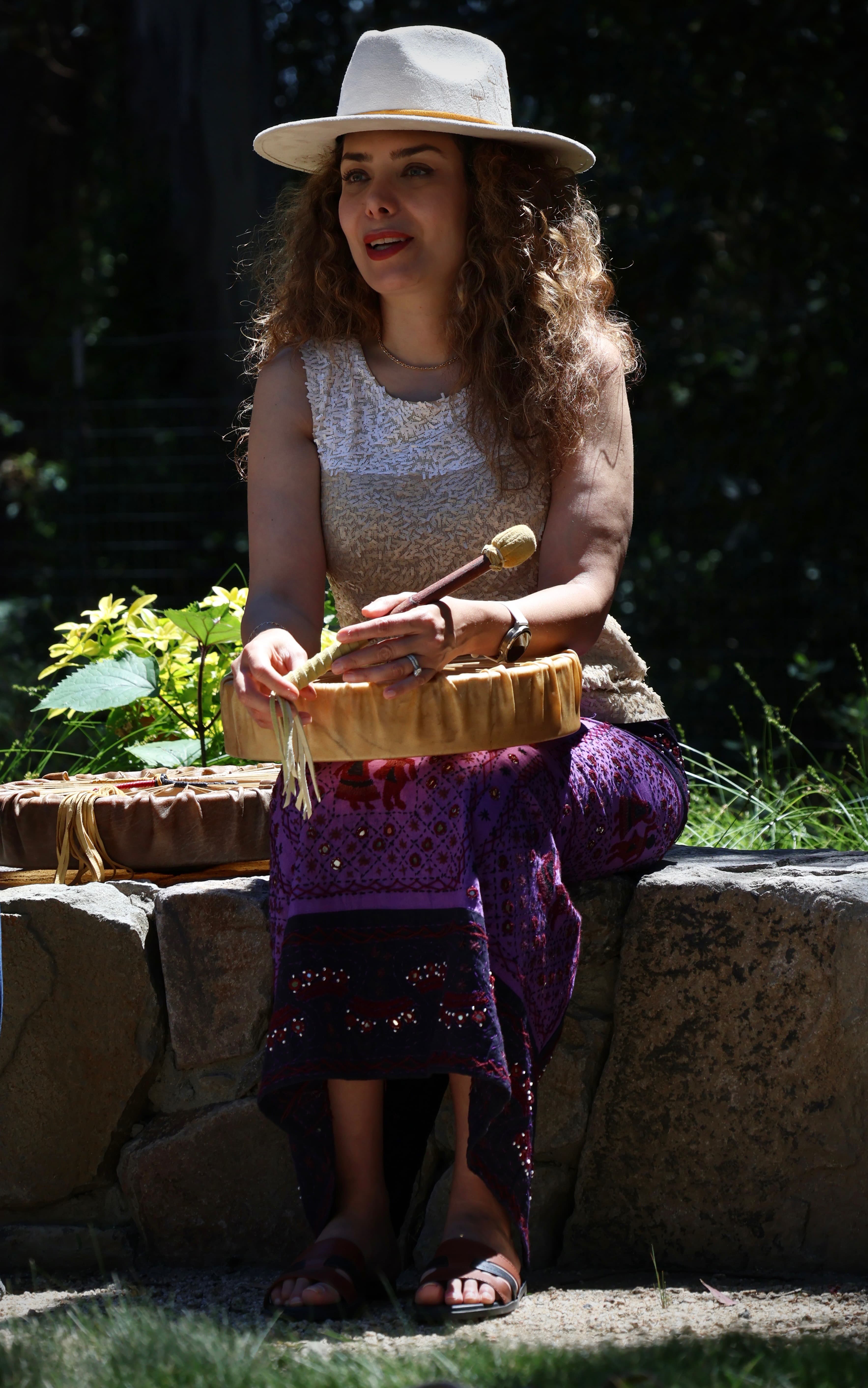
As my own practice deepened, I found myself increasingly drawn toward creating spaces where others could slow down, connect, reflect, and feel supported. I began facilitating circles, integration gatherings, ceremonies, retreats, and other community spaces. Over time, I realized that this work was becoming much more than an interest.
It was becoming part of how I wanted to serve.
How I Approach Healing
I don’t believe healing belongs to any single tradition, modality, religion, or philosophy.
My scientific background has taught me to value evidence, boundaries, ethics, accountability, and humility.
My embodied and spiritual practices have taught me about presence, relationship, intuition, ritual, community, and reverence.
I am interested in the bridge between these worlds—not in replacing one with the other.
I have studied somatic and nervous-system-focused practices, craniosacral work, sound healing, psychedelic-assisted approaches, meditation, ceremony, and preparation and integration practices.
But I don’t believe healing is ultimately about collecting techniques.
The more I learn, the more I believe the heart of this work is deepening presence.
It is meeting another person with curiosity rather than judgment.
Listening deeply.
Respecting their autonomy.
And creating enough safety and spaciousness for whatever needs attention to emerge in its own time.
What It’s Like to Work With Me
Above all, I want the spaces I create to feel human.
You don’t need to arrive with the right words, a perfectly formed intention, or even a clear understanding of what you need.
We can begin exactly where you are.
My role is not to tell you what your experience means or to position myself as someone who has the answers for your life.
I see my role as accompanying you—with presence, curiosity, care, and respect for your own inner knowing.
Ethics, consent, confidentiality, and clear boundaries are foundational to how I approach this work, particularly when people are entering vulnerable or altered states.
Responsible care also means understanding the limits of my role. At times, the most supportive thing I can do is recognize when someone’s needs fall outside my scope and encourage them to seek appropriate licensed medical or clinical support.
Still a Student
Perhaps one of the most important things I can tell you about myself is this:
I consider myself a student of life.
I hope I always will.
I remain deeply grateful to the teachers, elders, mentors, practitioners, and communities who have shared their knowledge and wisdom with me. I continue to seek education, mentorship, supervision, and community because I don’t believe this kind of work should be practiced in isolation.
Underneath the education, practices, and titles, I am another human being walking my own path—learning, changing, making mistakes, becoming more curious, and trying to meet life with greater presence and an open heart.
What continues to call me forward is the possibility of bringing together science and spirituality, rigor and reverence, individual healing and community.
Ultimately, I hope to help create spaces where people can reconnect—with their bodies, with themselves, with one another, and, if it is meaningful to them, with something larger than themselves.
Maybe healing, like home, is ultimately about finding our way back to belonging.